

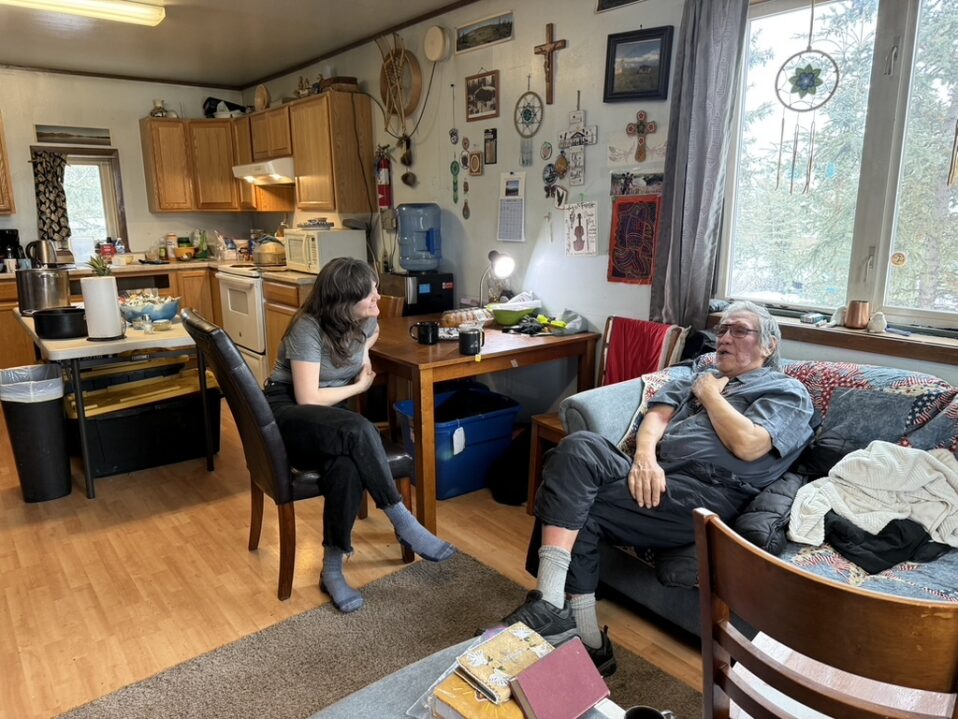
For more than two decades, Becky Hill has immersed herself in the living traditions of American music and dance. A nationally recognized percussive dancer, square dance caller, choreographer, folklorist, and cultural program leader, her work bridges performance, community, and cultural preservation. In the fall of 2024, while coordinating events for the National Endowment for the Arts’ National Heritage Fellowships in Washington, D.C., she met Gwich’in elder, fiddler, and National Heritage Fellow Trimble Gilbert (pictured with Becky at his home/photo by Jamie Fox).
With travel support from the Center for Cultural Vibrancy, what began as a chance encounter grew into an extraordinary journey. Amid the bustle of events at the White House, Library of Congress, and Kennedy Center, Becky found quiet moments talking with Trimble Gilbert about his home in Vashraii K’oo—the Gwich’in name for Arctic Village, Alaska. Those conversations led to an invitation to visit his community and experience its vibrant dance and music traditions firsthand.
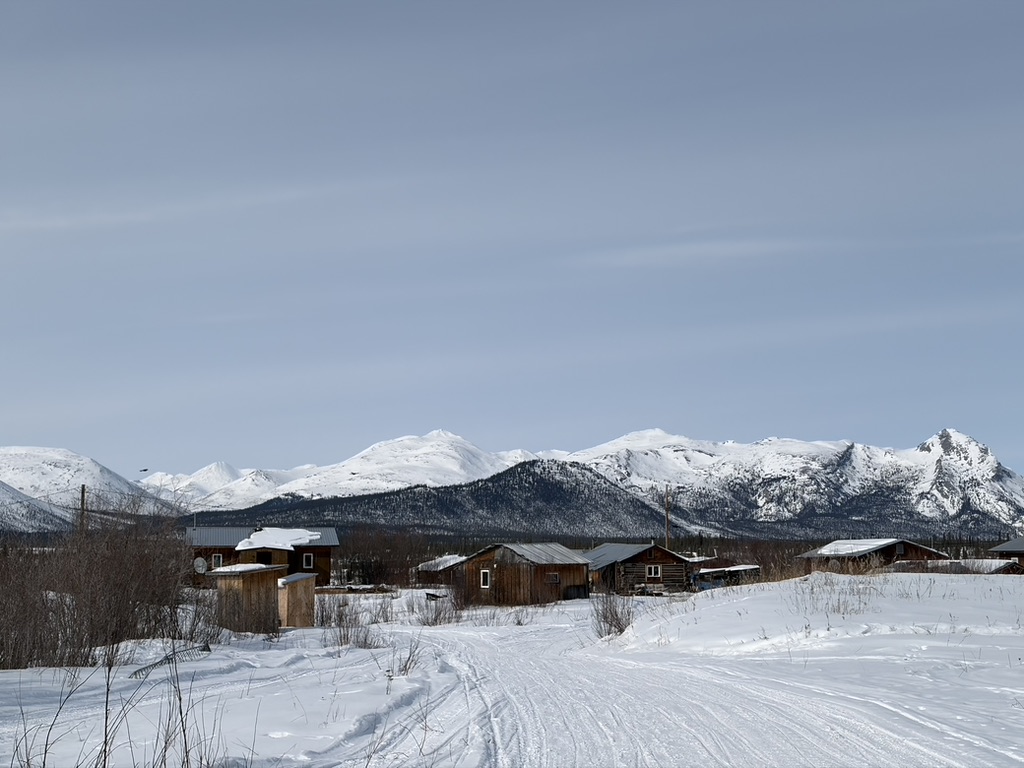
In this conversation, Becky reflects on the path that brought her there, the remarkable parallels she found between Arctic and Appalachian traditions, and the enduring power of dance to build connections across cultures, generations, and geography.
Jon Lohman: Looking back, does the trip still surprise you?
Becky Hill: It was a totally different world, but it also reminded me that these rich pockets of culture exist everywhere. Yes, I flew to Arctic Village, but there are communities with that same kind of vitality in our own backyards.
I look back and think: How did I end up there? But at the same time it also felt familiar. I’d spent years documenting dance traditions in West Virginia, sitting in musicians’ homes where they kept offering you food and coffee and stories. Being welcomed into someone’s home, learning from elders who were excited that younger people cared—that all felt deeply familiar.
Jon: What struck you most about the dancing in Vashraii K’oo?
Becky: Dance immediately created belonging. I was obviously an outsider as a young white woman who wasn’t connected to a local family. But once I put on my dance shoes and joined in, everything changed. Suddenly people were saying, “Come sit with me,” offering me food, introducing me to elders. I was joined on my trip by my good friend and Métis fiddler Jamie Fox, who joked I was getting marriage proposals by the end of the night.
That’s the power of social dance. It creates community almost instantly.
Jon: Were there dances you encountered there that especially stood out to you?
Becky: What amazed me was how familiar some of the dances felt. There was a large circle dance that reminded me so much of dances in West Virginia. I showed footage to Jesse Milnes, son of my mentor at Augusta, Gerry Milnes, and we both couldn’t believe how similar they looked!
The biggest difference was that everyone jigged through the entire dance (referring to rapid, syncopated footwork). In many Appalachian square dances, people walk between figures. In Arctic Village, everyone kept doing footwork the whole time. You don’t walk through the dance—you jig through it.
Jon: One of the most interesting moments you described involved working with community members on their native language and dance terminology. Can you share more about that?
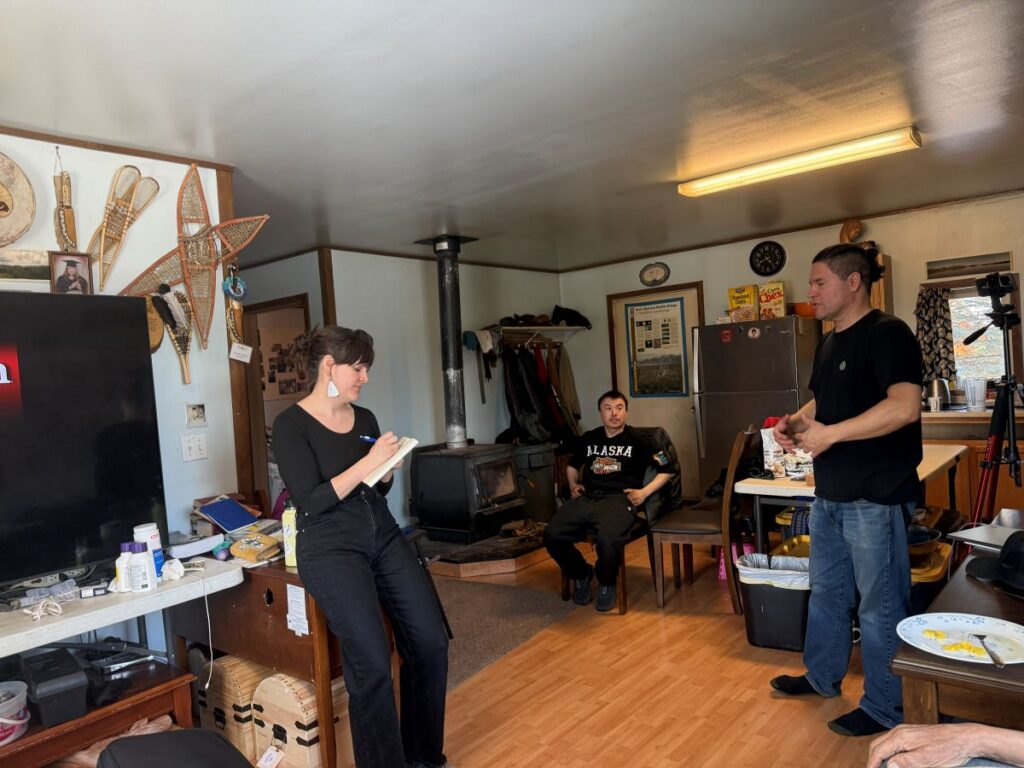
Becky: We spent an afternoon with elder Trimble Gilbert and community dance leader Taa’aii talking through traditional dance figures. Taa’aii knew all of the dances but not necessarily the English square dance terminology.
For example, what I would call a “grand right and left,” he immediately recognized as what they describe as a “braid.” Instead of simply borrowing English terminology, we were talking about how these movements could be described in Gwich’in in ways that made cultural sense.
That was really exciting because it wasn’t just documenting dance—it was supporting language revitalization at the same time.
Jon: Tell us a little about you… How did dance become such a central part of your life?
Becky: I’m really a product of the Folk Revival. My family took me to Wheatland Music Festival when I was 16 months old, and I was captivated by the dancing. My parents put me in tap class when I was two. My neighbors took me to my first square dance, and I grew up surrounded by traditional music and dance in rural Michigan.
By the time I was twelve, I received a Wheatland scholarship to attend Augusta Heritage Center, in Elkins, West Virginia, where I studied with some of the country’s great traditional dancers. That experience changed everything. I apprenticed with professional dance companies before graduating high school, and I’ve spent my career following opportunities that grew out of that community.
Jon: Your career combines performing, teaching, documenting traditions, and cultural work. Was that intentional?
Becky: It’s all branched off the same tree. I never really separated dancing from documenting culture or working with communities.
There wasn’t some grand plan. I kept following my curiosity. One opportunity led to another—from dance, to folklore work in West Virginia, to documenting traditions, to becoming a square dance caller because elders literally handed me the microphone and said, “You’re next.”
I love that balance. Dance is what I do, but projects like heritage documentation connect me with incredible artists and communities. If I only did one or the other, I’d miss half of what makes this work meaningful.
Jon: What do you hope comes next with this project?
Becky: I’d love to continue documenting these dances alongside community members and experienced dance scholars, then hand that knowledge back to the community so they can translate it, teach it, and continue reclaiming it.
To me, that’s the most exciting part—not simply preserving tradition, but helping create tools that communities can use themselves.
Read Becky’s firsthand account of this exciting journey and impactful cultural exchange below.
By Becky Hill
Two years ago, in the early fall of 2024, I met Revered Trimble Gilbert, an Episcopal priest, tribal leader and acclaimed Athabaskan fiddle player, on his trip to Washington D.C. to receive the NEA National Heritage Fellowship, the United States’ highest honor in folk and traditional arts. I was recruited at the last minute to step in for a mentor and colleague, and to run the NEA Heritage events at the White House, Library of Congress and Kennedy Centers. I felt well in over my head. I remember trying my hardest to track every tiny detail, to show care and respect for the Fellows, and to make sure everything went off without too many mistakes. It was in the midst of this frenzied experience that I met Trimble along with his grandchildren Chief Galen, Curtis and Jewels. Trimble exuded his trademark calm demeanor and in the whirl of coordinating I found myself taking in tiny moments of rest by sitting next to him on a bench, or volunteering to push his wheelchair through the hallways of the Kennedy Center. In these moments, he began to tell me stories of his home along the East Fork of the Chandalar River along the eastern Brooks Range in interior Alaska.
We quickly connected over fiddle tunes and square dancing, and by the end of our time together I had received a warm invitation to visit Vashraii K’oo, his home, the Gwich’in name for Arctic Village. One thing to note is I am a square dance caller and flatfoot dancer and have been immersed in folk traditions since childhood. Inspired by elder dance callers I met while working on Augusta Heritage Center’s Mountain Dance Trail I have spent the last fifteen years calling square dances.
Over the course of the next two years Trimble would occasionally call and re-invite me to visit. In December 2025 he called around the middle of month, inviting me to his community’s New Year’s Celebration. I was equal parts flattered and daunted. Getting there from Washington D.C. is quite the journey, a roughly twenty hour flight beginning with a stop in Seattle and a transfer to another plane to Fairbanks. From this already distant Alaskan city, one must take a charter plane 230 plus miles north to Vashraii K’oo, a remote village in the Alaskan interior with no connecting road system. Unreachable by car or boat, Vashraii K’oo is accessible only by charter plane or an over a hundred mile snowmachine journey. Pulling off a visit for New Year’s seemed out of the question, so we began to scheme a visit for Spring Carnival. I’ve learned over the years that when elders nudge you to do something, they often have something up their sleeve. There was a reason Trimble wanted me to experience the Neets’aii Gwich’in music and dance traditions. Though I didn’t know the reason, I knew Trimble had one, and I wanted to find out why.
With Trimble having just celebrated his 90th birthday, and time feeling increasingly precious, I felt an urgency to make the trip before it was too late. I immediately called Josh Kohn and Jon Lohman at The Center for Cultural Vibrancy, who graciously offered to support the trip by covering my travel expenses. I waited until the dates for Spring Carnival were announced and then began to plan. During the process I found out from a mutual friend that Jamie Fox, a Métis-style fiddler from the Fort Belknap Reservation in Montana was planning on making the trip to Spring Carnival with her dad, Jim. This was Jamie’s 4th visit there, and she encouraged me to make the trek, agreeing to show me the ropes. After chatting over the phone, we decided to coordinate our arrivals.
On April 11, Jamie and I met in the crowded Wright Air Service lobby. I’m sure I was emanating anxious energy. I had never been on a six seater bush plane before and was definitely travel weary and sleep deprived. After some time, our names were called and we boarded the bush plane. Mid flight, high above the boreal forest, my eyes scanned the landscape searching for wildlife. The woman seated next to me nudged me with her elbow and pointed out a large caribou herd stretched across a frozen river. The Neets’aii Gwich’in often refer to themselves as the Caribou People, and I couldn’t help but believe this sighting was a good sign for the trip.
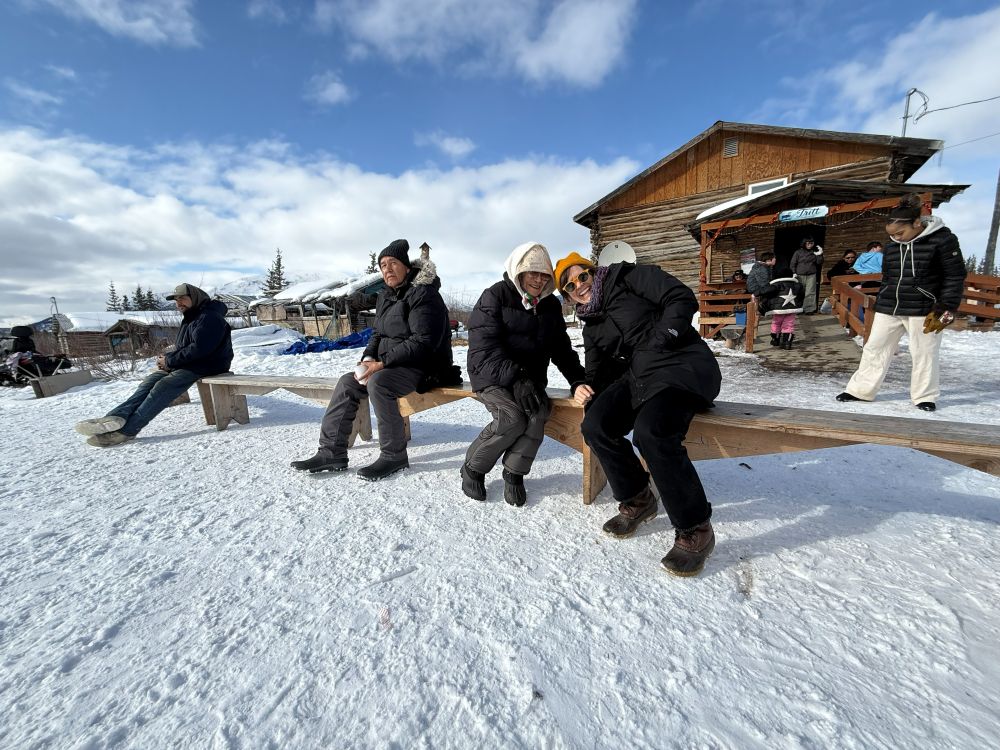
As the plane landed in Vasharii K’oo it was swarmed by snowmachines and a lone pick-up truck, all there to collect visitors and supplies. The view from the airport was breathtaking, with Tsuknadhat, Dachanlee, Neetsidhaa, K’iiveetiinlii and Tthaaeetsii Mountains surrounding the village. I was greeted by Jewels and Chief Galen with a hug and “you finally made it here!” On the back of Galen’s snowmachine, we passed beneath a banner on the main road that said “Welcome to Arctic Village Spring Carnival.” I had arrived. My face was chilled by the five degree weather as we zipped through the village. Galen pointed out the community hall, church, general store and tribal council, as he took me to the Arctic Village School. Everything felt vast and unknown.
The Arctic Village School, regularly hosting out of town travelers, would serve as accommodations during my visit. I set up a cot in Ms. Rose’s 1st-4th grade classroom and the dance musicians stayed in the Kindergarten room across the hall. Twenty-four K-12 students attend the school, in session during my visit, which meant –somewhat dauntingly – that I’d have to clear out of the classroom by 8 a.m. every morning, no matter how late the dance went on the night before. Still, there was heat, running water, a place to lay my weary head, and a pot of coffee always on.
Chief Galen gave me a brief run down of Spring Carnival events and encouraged me to rest until the kick-off potlatch and dance that evening. Before I could even unpack my bag Jamie came by, and once again I was off on a snowmachine to visit Trimble. We spotted a snow hare on the way to his house, camouflaged by the layer of snow, still blanketing the ground in April. Trimble’s home was a two-bedroom, hand-built cabin shared with his wife Mary of seventy-three years. The house was filled with remnants of a life well-lived: photographs of family and friends plastered the wall, numerous awards Trimble had been honored with were on display, and beautiful beaded artwork created by both Mary and Jewels sat prominently. “What took you this long,” he said, greeting me with a smile. He had a pot of caribou ribs on the stove, and we feasted and chatted. I felt a sense of familiarity. I had been to houses like this before, when I had visited elder musicians and square dance callers all throughout the mountains of West Virginia. This didn’t feel all that different from those experiences, which continually reminded me of the common threads that connect people across vast cultural and geographic distances. Eventually the heat from Trimble’s wood stove roasted us, causing the yawns to take over. We wrapped up our visit and made plans to meet at the community-wide potlatch later.
I rested hard, and barely made it to the potlatch on time. I learned quickly that time operates differently in Vashraii K’oo. One couldn’t completely trust the written schedule of Spring Carnival events, having instead to attune to the ebb and flow of the community as it happened in real time. Dinner started when the food was ready, and people were gathered no matter what time was listed on the schedule. When I stepped foot into the community hall, almost all of the 150 residents and guests had gathered. They knew what time the potlatch was. A prayer of thanks was said and guests and elders were served first, followed by the children, then everyone else. The potlatch stretched down the hall filled with dishes of caribou ribs, chicken bbq, wild goose, moose head stew, potato and macaroni salad, stir fry, salad, pizza, fry bread, cake, and many more dishes lost to my memory. I noted plates made up for those elders not present, and recalled those who had prepared them leaving on their snowmachines to deliver the food, all before taking their first bite.
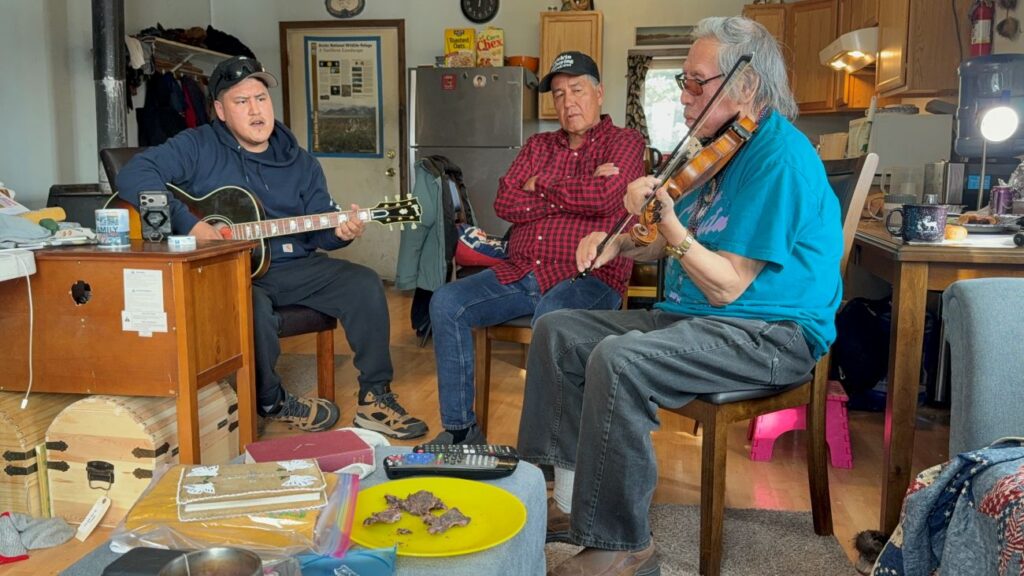
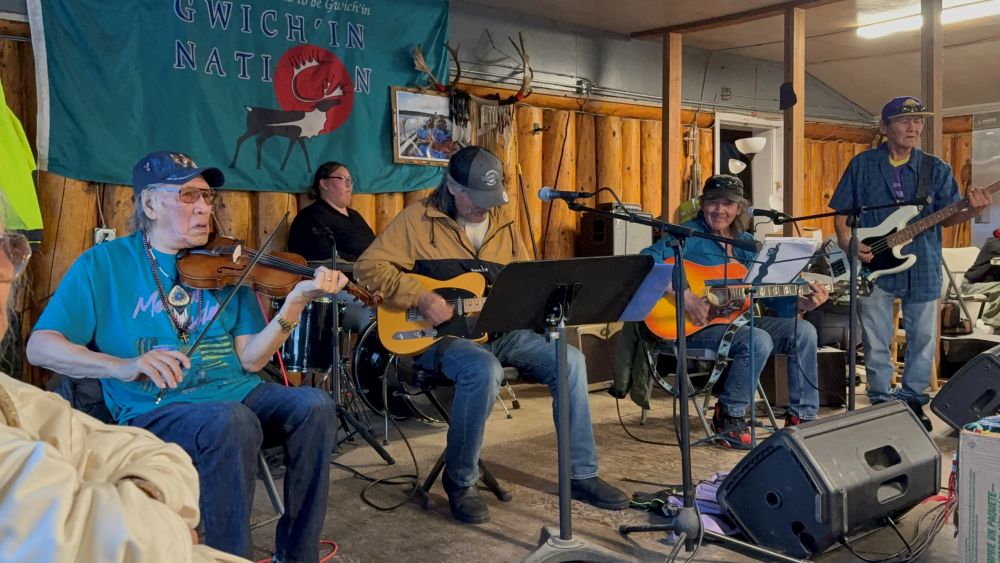
After the feasting subsided, there was a bit of a lull before the dance started. Little kids ran around in their snow boots playing tag. Tables were cleared, and folks would sit and chat as they sipped their coffee and tea. Gradually the band assembled, and Hank Williams’ “You Win Again”started out the evening. Trimble was on fiddle backed by drums, electric guitar, acoustic guitar, and an electric bass. The instrumental music that exists in Vashraii K’oo arrived through Scottish, Irish, French Canadian, and Métis explorers, traders, and missionaries. Over the course of a night I heard two-steps, waltzes, hoedowns, jigs and reels and gleefully absorbed the accompanying dances. Trimble had told me previously that there were once square dance callers in their community, but that the tradition had nearly disappeared. Today, dance leaders guided the dances from the floor, leading by example. One of those leaders was Kyle, an exuberant dancer eager to dust off his beaded moccasins. As leader for the evening, Kyle initiated the dances of his choosing, save for times the band signaled a particular dance by playing its associated tune. The curation of the evening’s dances revealed to be a shared effort between the musicians and the dance leader. Classic country songs were featured just as much as Athabascan fiddle tunes, and many dancers gracefully two-stepped over a waltz.
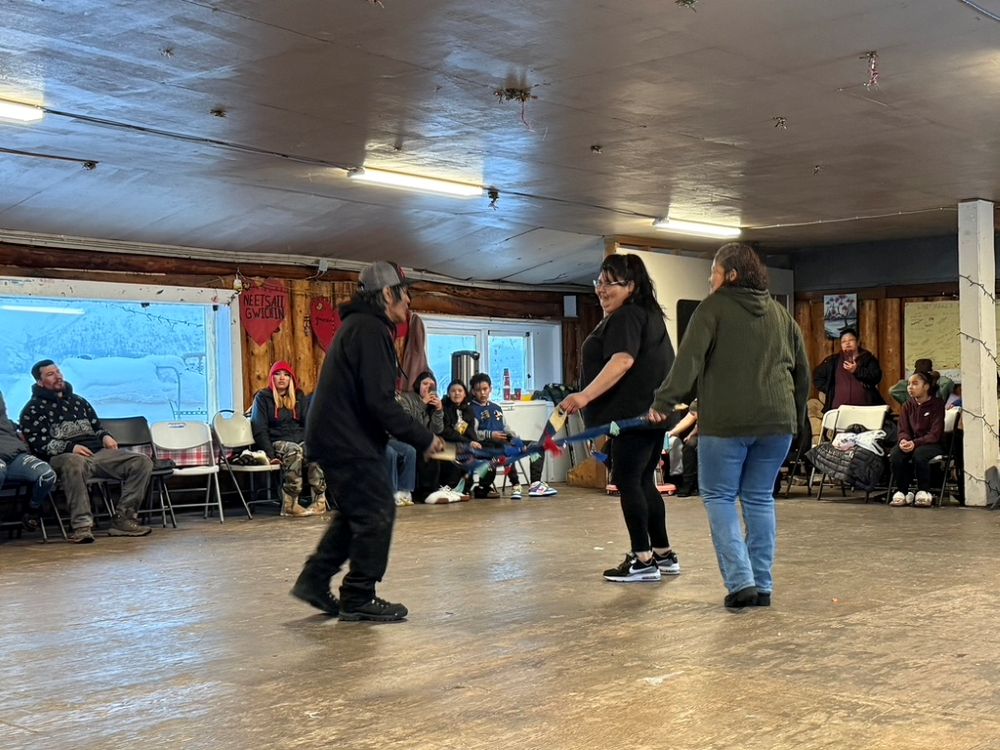
Throughout the night, the floor was filled with dancers of all ages as the Rope Dance (Neets’ee Tl’yaa), Red River Jig (Jig Ahtsii Ch’aadzaa), Duck Dance (Dats’an Ch’aadzaa), Brandy (Varandii), Broom Dance and Handkerchief Dance (K’ooniit’aii Ch’aadzaa) were played. I was a little hesitant to jump into the first square dance, but quickly learned nervousness had no place on the dance floor. The Red River Jig, a freestyle dance done in pairs, featured dancers jigging to the tune in an almost flirtatious manner until another couple entered and took center stage. Curtis, Trimble’s grandson, urged me to dance this one with him, and after folks witnessed my flatfooting I happily had invitations to dance the rest of the evening. The square dances were not taught, and if you were new you just had to hold on and hope your partner knew what they were doing.
A few of the other dances I participated in that evening were the Duck Dance, Brandy and Handkerchief. The Duck Dance repeated a structure of three, with three couples in pairs doing three different patterns (forward & back, peel away and duck & dive) three times. The Brandy Dance seemed similar to a Virginia Reel, done in long lines across from one’s partner. Lastly, the Handkerchief Dance was done in a trio, with the person in the middle holding two custom decorated ribbons in each hand and the outside dancers holding the ends. The middle dancer would then lead a series of turns while improvising jig footwork, all while holding the ribbon. Similar to the Red River Jig, trios lined up and took turns dancing.
Some of these dances lasted as long as twenty minutes, and the band would quickly lock into a solid groove, providing the drive that kept the dancers going. Trimble told me he watched the dancers, “always finding the best one to keep my fiddle playing going.” When the band needed a break, Hilly stepped forward to lead a game and the room echoed with laughter. At these dances, door prizes were handed out throughout the evening, and at least fifteen were given away on that particular night. Prizes ranged from tarps to gloves, jackets to coffee cups. People stayed at the community hall until the last door prize was awarded, and the last fiddle tune was heard. There was a feeling of celebration in the air; another Spring Carnival had arrived.
Time in Vashraii K’oo seemed again to stretch, bend and twist, and it was mid-afternoon sooner than I expected. At around 2pm, many gathered around the center of the village for games and food. Benjamin, who had woken up early and tended the fire, had made a big batch of caribou soup and a pot of coffee over the hot coals. Hot dogs and burgers were grilled and eaten. No one went hungry. Folks sipped their Red Bull zingers–a favored beverage– and competed in the games for cash prizes. Sometimes the contest would be an egg toss or wheel barrow race, other times a rifle shooting competition or a snow shoe race. There was even a caribou head-skinning contest with men’s and women’s divisions. The elders smoked everyone else by a long shot, with the fastest time being one minute and thirty-eight seconds for a full skinning. I was seated in the front row taking in the contest with a beloved elder, Florence, (Trimble’s sister), who fed me the secrets of everyone’s technique. One of my favorite contests was the dizzy-stick race, where contestants had to touch their foreheads to a stick and spin around at least 20 times and then run to the finish line. Their pathways were, unsurprisingly, not the least bit straight, and laughter rang out through the village as one after another careened off course, occasionally collapsing in a dizzied heap.
After several evenings of square dances, a game of village-wide BINGO was scheduled, and the promise of cash prizes kept everyone in the community hall. A giant barrel stove cranked out the heat, and rows of six-foot tables were lined up throughout the hall. A visiting preacher from Maryland was recruited to run BINGO, and quickly became the target of jovial heckling: “Speak louder!” “Can you repeat that?” “You’re talking too fast.” “You’re talking too slow!” He remained a good sport, his commitment to dad jokes admirable. Groans of disappointment filled the air as the numbers were called, occasionally interrupted by jubilant cries of “BINGO!” Laughter erupted in short bursts from individual tables as the game’s frenzy caused the evening to slip by.
In the days to come, more planes arrived in Vashraii K’oo with visitors, and the community hall was filled with several more new faces. One of those faces was Taa’aii, a respected dance leader and Gwich’in language preservationist. It was determined that we should meet each other, and we were quickly introduced. Almost immediately upon meeting we hatched a plan to go to Trimble’s house the next day, bringing Kyle and Jamie with us. Taa’aii had been collaborating with Trimble on projects to revitalize the Neets’aii Gwich’in language, and both of them believed that learning to call square dances presented an important opportunity to teach and practice their native language through dance. Inside Trimble’s home, the wood stove blasting as always, all four of us worked through traditional Gwich’in square dance figures, step by step. Trimble and Taa’aii taught the figures, followed by me sharing the way I would call or teach them back home: “That’s an Allemenade left, and right and left grand,” and so on. Next, Taa’aii would look to Trimble to translate the dance terminology back to Neets’aii Gwich’in. And there it was, or so I thought I realized: the reason Trimble had invited me to Vashraii K’oo. He had seen a potential to both revive the traditional square dances figures and their language; and to do so simultaneously, through the reinvestment in their beloved dance traditions. In this long, warm afternoon together, we managed to translate a handful of square dance figures, going back and forth for hours, until the dancers we had recruited were dripping in sweat and (perhaps more than slightly) dehydrated. The afternoon was invigorating, but the time seemed to slip by yet again, and before we knew it the potlatch was fast approaching. Reflecting on the day’s work, Taa’aii and I realized there were many figures only the elders such as Trimble seemed to remember, and that a larger effort to document these traditions was perhaps warranted to ensure the dances remained.
My last night in Vashraii K’oo had arrived, and a talent show was upon us. I found myself roped into being an anonymous judge. The show kicked off with the emcee reminding everyone why we were there, making the audience repeat a mantra after her saying, “I am brave. I am talented. I am beautiful. I am a badass.” Songs were sung in sparkly dresses by little ones, poems were shared, a Wagon Wheel sing-along was led, and there was even an appearance by a tiny spiderman. I got called out during a stand-up comedy set by Hilly and challenged to a jig dance off. I found joy in the roasting and in the midst of it, I felt I had been accepted by this community. At that moment, the only way I knew to show my gratitude was to lean my head back and belly laugh.
Following the talent show, Trimble, knowing it was my last night, instigated yet another impromptu square dance. The fiddles didn’t launch into gear until around 10 p.m. and we danced until well past the new day. Taa’aii led the evening’s dancing, introducing me to dances I hadn’t yet tried like Eight Couple (Nihk’iidoo). When the moment felt right, he would step into the center with his partner, which was often me, and others would quickly circle up. Each dance leader brought a distinct style to how they guided the evening’s dance and Taa’aii’s style was to attune to the energy of the room to shape the flow of the night. We danced in circles and squares, in duets and trios, and when it came time for the last dance Trimble asked me to two-step. In that moment, I knew I was where I was supposed to be: there, in that place, with the dance rolling us up into its universal language. By inviting me to his village to experience Neets’aii Gwichin’ dance traditions, I believe Trimble knew I would leave with a deep respect for Gwich’in culture, and a deeper understanding of how interconnected we all really are.
As I flew over the interior of Alaska on the six seater bush plane, beginning my twenty hour journey back to Washington D.C. I was overcome by a sense of deep gratitude. The Brooks Range loomed in the distance and the pines were but countless tiny specks from our height. I felt changed, but also deeply fortified in my belief that choosing joy is a radical act. I knew daily life in Vashraii K’oo can be hard, that it wasn’t Spring Carnival everyday. Yet joy there was no accident. It was a practice. The residents chose it, returning again and again to their culture, place, and the deep ties of community.
