

By David Bearinger, event co-curator.
Picture a family fleeing war in El Salvador or Ukraine, genocide in Cambodia, or the repressive regime in Syria. Imagine a place that has been home to a dozen or more generations of your family and where nothing is safe there anymore.
Picture a woman, now in her 40s or 50s, who came of age in a refugee camp in Jordan or Sudan and is now living somewhere in Virginia. It could be in Richmond. A son whose father sold or mortgaged everything to send him “north” from Honduras because the only other options were to join a gang or be killed.
Picture a doctor or a teacher, or an artist facing imprisonment and likely death because their beliefs or something they did violated a fundamentalist decree. Picture how and why they leave their homes.
Look farther back in time. Beneath the superficial differences, the picture you see is the same.
Imagine the waves of immigrants coming to this country a century, two centuries ago: from a land beset by famine, or from the ruins of the Austro-Hungarian Empire, crossing the Ocean, seeking refuge.
Imagine a son or daughter, or a young married couple with a new grandchild, saying goodbye to families they know in their hearts they will likely never see again, stepping onto the boat and looking back one final time; or not looking back because the pain of leaving is too great.
Not everyone who makes the decision to migrate is impoverished, in mortal danger, or facing some form of persecution. Some of those who come are already well established in their careers with even greater opportunities waiting for them here; others come initially as students and decide to stay.
The point is, the migration journey is complex, and it’s not the same for any two people who make it, even siblings who arrive together and who grow up in the same household, striving to learn a new language, to assimilate, to fit in, to become an “American,” whatever that word means to them.
Know, too, that whatever it starts out to be, this idea of what it means to be an American can also shift or be displaced as the years pass, maybe when children are born and start growing up with hyphens bolted to their identities, struggling to let go of the past and hold onto it at the same time…
In a way, it doesn’t matter whether an immigrant arrives with no material possessions, literally carrying nothing but the clothes he was wearing when he fled or left home. Or whether he comes with abundant material resources: that only means the migration journey plays out in other ways, in other corners of the heart.
What nearly all immigrants—and refugees too—have in common is the nagging question of identity, of who am I? For many, it’s a lifelong struggle to answer this question. But it’s a struggle that can be joyful, too, an affirmation and embrace of the complexity, even the hyphens; of a bicultural identity that evolves and stays connected at the same time through various forms of expression.
Which is why so many immigrants cherish the arts of their home countries, the ceremonies, the traditional foods and ways of dressing, the rituals and forms of daily practice they bring with them, even when they come with nothing else; and that thrive and keep growing here, like trees replanted in new soil.
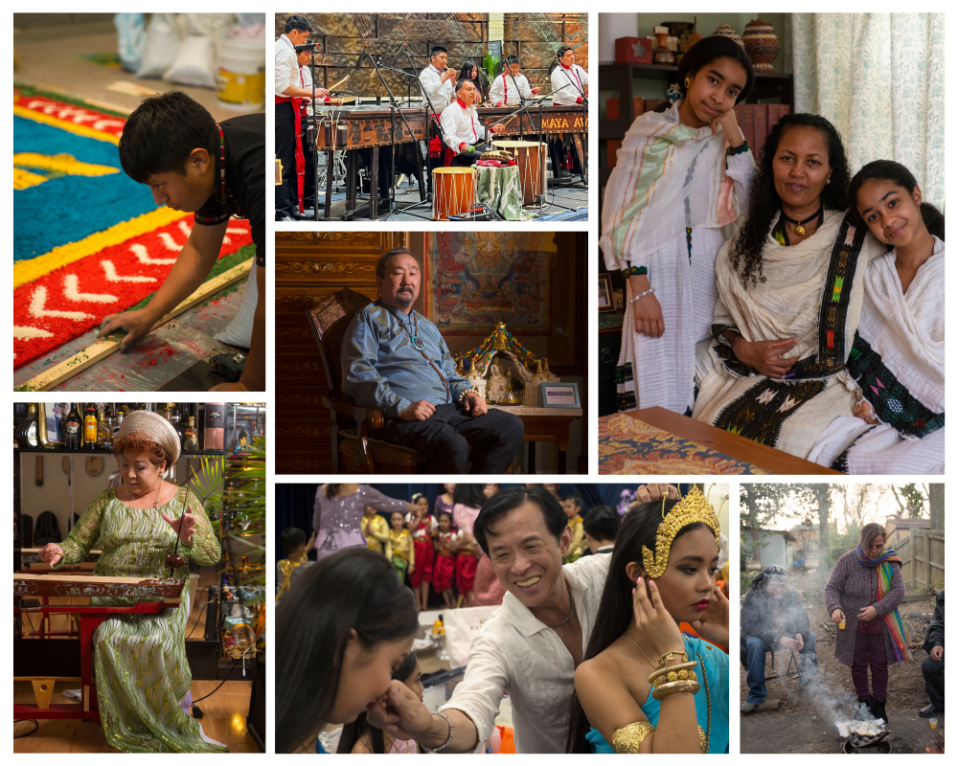
This is some of what audiences will see and experience this Saturday, March 28, in an event that celebrates the expressive and artistic traditions recent immigrants and refugees have brought with them to Virginia.
The event, Commonwealth Crossroads, will take place at the Virginia Museum of History and Culture in Richmond, just one week after the opening of a new VMHC exhibition—“We The People,”—that explores the history and stories of immigration in Virginia from the founding of the United States until the present day.
Commonwealth Crossroads is both a showcase and a celebration, one that features traditional musicians and dancers from Bolivia, Mongolia, Vietnam, Cambodia, and Guatemala, along with demonstrations, installations, and ceremonies ranging from Guatemalan Alfombra to Ethiopian Coffee Ceremony to a welcoming Ceremony, in the Quechua language, performed by a native speaker from the Bolivian Andes.
This event is brought together by the Virginia-based Center for Cultural Vibrancy.
This event is not about politics, it’s not about immigration policy or recent events. But it is an affirmation of the richness that immigrants and refugees bring with them to Virginia, whatever form their own migration journey takes.
As different as these traditions are from one another, they play similar roles within the communities and cultures they come from. They flow and merge together with other, more familiar traditions, refreshing and enriching the “common wealth.”
Commonwealth Crossroads is a rare opportunity for Richmond to experience these traditional art forms directly, as they interact with one another. It’s also a reminder that variety and commonality don’t just coexist, they are two faces of the same coin.
The phrase e pluribus unum (“Out of many, one”) was proposed in 1776 by a committee that included John Adams, Benjamin Franklin, and Thomas Jefferson and later adopted by Congress in 1782. It appears on the Great Seal of the United States, on U.S. currency, even on the seal of the President of the United States.
In a time of great upheaval and discord, much of it surrounding immigration, Commonwealth Crossroads also serves as a challenge, to think again about this phrase, e pluribus unum, and what it means to us in Virginia today.
